Saturday, April 12, 2014

10 Essentials for Easter Vacation with your Dog

Easter is quickly approaching, and here in Norway where I live, that equals long skiing trips and a lot of time spent outdoors. It also means that we go away from home, to relatives living far up north or to a cottage in the mountains. And of course we bring our canine companions with us, so here comes a list of the 10 most essential things you will need for your Easter vacation (or skiing trip) with your dog:

1. Harness and elastic leash


Link in his Non-Stop dogwear harness.
 Many people want's their dog to pull them when they go skiing with the dog. This is called skijoring and is really fun, at least as long as you have taught your dog some basic obedience and commands like "stop", "slower", "right", "left" and "go". Just imagine how uncomfortable it must be for the dog to pull you wearing a collar or a harness not made for pulling. Make sure you have the right equipment, and the ski trip will be fun for both you and your dog.

2. Socks and Paw cream

Link wearing socks before a walk.
 To avoid sore paws and snow and ice sticking to your dog's paws, always use a paw cream when you are outdoors with your dogs for any longer periods of time. This will make sure your dog doesn't get sore feet and that dirt and ice won't get stuck between the pads causing discomfort for the dog.
To protect your dog's paws even more, or if you see that the paws are a bit sore already, use socks. This will shield them from further wear and like the paw cream, keep the paws clean and free from ice. There are several kinds dog socks on the market. Just make sure that the socks you use don't have seems on the inside, as it may cause chafing on your dog's paws. Also make sure that the sock isn't to tight. You don't want to restrict blood flow to your dog's paws! Always check your dog's paws regularly when it has socks on to make sure they aren't doing more harm than good.'

4. Eye drops

This is a sign that your dog has an eye infection. You can try using normal moisturizing eye drops, but if the problem persists you have to take the dog to the vet.
 Eye drops to prevent the dog's eyes from getting dry. When out all day in the snow, with possible cold wind and bright light, your dog's eyes can become dry and irritated. This can lead to infections and inflammation of the eye. Just use normal moisturizing eye drops that you find at the pharmacy. If in doubt about if a certain type can be used on your dog, ask your veterinarian.

5. Bandage material

Link's front paws had to be bandaged after he had been out playing in icy snow at the cottage. Two of his claws were worn down so much they were bleeding.
 If your dog gets hurt during your vacation, you might well find yourself far away from the nearest veterinarian. At this point you will just have to make do with what you have, and if you have prepared and brought some bandage material you can help your dog right away. Now, I'm not saying that you don't have to go to the vet if your dog gets hurt, of course you do. But until you get there your dog will not be able to lick or bite at the wound or get dirt in it, if you've put a bandage on.

6. High energy snacks

You should never just go from no or little activity, to a lot of activity with anyone, dog or human. So make sure that if you are going skijoring with your dog that the dog is in shape to do it. If you are in doubt if your dog is healthy enough, get it checked by the vet. That being said, you will very likely be a lot more active with your dog during Easter than you have been for a while. That means that the dog is going to need some extra energy. Always bring some high energy snacks with you. There are ready made snacks that you can buy or you can just make some yourself. Also if your dog does not eat snow, make sure you offer it water to drink.

7. Food for dogs with sensitive stomachs


 All the time spent outdoors with your dog is going to give the dog plenty of opportunities to eat stuff that it finds (and most likely shouldn't eat). This means that your dog might get an upset stomach. The increased activity can have much the same effect. And again you might find yourself far away from the nearest veterinarian or even food store. While you can boil rice and skinless chicken breasts and feed to your dog in small portions, I find it much easier to use some of the pre-prepared diets that you find at the vet. I for my sake never go on trips with my dog without bringing some cans of i/d from Hill's .

8. Probiotics


 I swear to probiotics. Whether you are changing your dog's diet, the dog is on antibiotics or your dog just has a sensitive stomach, probiotics always help. I use something called Zoolac, that contains "good" bacteria and "food" for them, which balances the intestinal bacterial flora. It basically cannot be overdosed, since all that will happen if you give the dog much more than it needs, is that it will have even more of the "good" bacteria. I'm not sure Zoolac is sold anywhere else than in northern Europe, but I'm sure that your local veterinarian has a similar product. 


9. Clothing - coverall for the longhaired dog. Warming jackets for shorthaired dogs.


My boyfriend's sister's dachshund wearing a winter jacket last Easter.
 If you have a long haired dog (and live somewhere where there is a lot of snow), you have probably experienced your dog being almost covered in big snow balls. This is not pleasant for the dog and can be prevented if you use a water repellant coverall on your dog. If you on the other hand have a short haired dog, it is likely to get cold when out in the snow, even if the sun has really started warming now. For shorthaired dogs I would recommend a warming jacket or coat.

10. Sunglasses


 To protect the eyes of your dog you might want to consider using sunglasses on your dog. The suns rays are as damaging to the dog's eyes as they are to yours. There are a number of different products on the market when it comes to protecting your dog's eye. Everything from stylish sunglasses to mesh goggles.


Wednesday, April 9, 2014

Training to become a Therapy dog!

Link will start training to become a therapy dog! I just got the confirmation that we got a spot at a therapy dog course. I'm so happy! Ever since it became clear that Link has ED (see separate posts: Elbow Dysplasia in my Golden Retriever) I've been looking for an alternative "job" for Link. So when I saw the ad for the therapy dog course, I contacted them and got signed up the same day.
This will be the second time they have this course here in Tromsø, first time they had it was two years ago, and they told me Link is actually going to be the first Golden Retriever to train to become a therapy dog here in Tromsø. Let's hope he will pass all the tests so that he will become the first certified therapy dog of his breed! The dogs that passed the test two years ago are (as far as I know) three Labrador Retrievers and one Chinese crested.

I think Link will become a good therapy dog.

I have been thinking about getting a dog that can work as a therapy dog before, but I have sort of forgotten about it lately. I had however bought a book about therapy dog work a few years back, and now I have finally started reading it. It's called "Therapy dogs: Training your dog to reach others", written by Kathy Diamond Davis. So far it's a very good read.


"Therapy dogs: Training your dog to reach others", written by Kathy Diamond Davis


So what is a Therapy dog?
Well, let's start with what it isn't. It is not a service dog. It does not have the same privileges as a service dog (being allowed in restaurants, in the cabin on planes etc.).  A service dog is a dog that helps a disabled person, it belongs to that person and has been specifically trained to assist that person with things him or her cannot do him-/herself.
A therapy dog has a handler that is not him-/herself in need of help, but they work as a team to help others. Therapy dogs can be used to help war veterans or trauma victims to process what they have been through, they can be used to help children practice reading or they can visit old or sick people living in institutions, among many other things. In short: A therapy dog is a dog that has been trained to calmly interact with people of different ages and with different health or mental issues. It always has it's handler with it during these interactions, and it is the handlers job to keep both the person interacting with the dog, and the dog, safe from harm. The handler must be good at reading the dogs body language, so that the handler makes sure the dog is having a good time. A happy dog is a good therapy dog.

So what does it take to become a therapy dog?
Well first off all, the dog must be trained to be calm and offer appropriate behaviors around people. (I will come back to exactly what that implies when I've learned this myself...) Then it has to pass a mental test, to make sure that the dog will never react aggressively towards people and will not be easily frightened by loud noises or unfamiliar situations. The dog has to be able to tolerate strangers handling it, and even to some extent handling things that can be mildly painful without reacting aggressively. In real situations the handler should be able to see that something might be uncomfortable for the dog and get the dog out of the situation. But children or people with certain medical conditions might by accident do something to the dog that the dog finds painful, and in that situation a therapy dog must react calmly and never bite or growl.

I'm so looking forward to attending the course and to see if Link passes all the testes. I can wait to start!

Sunday, April 6, 2014

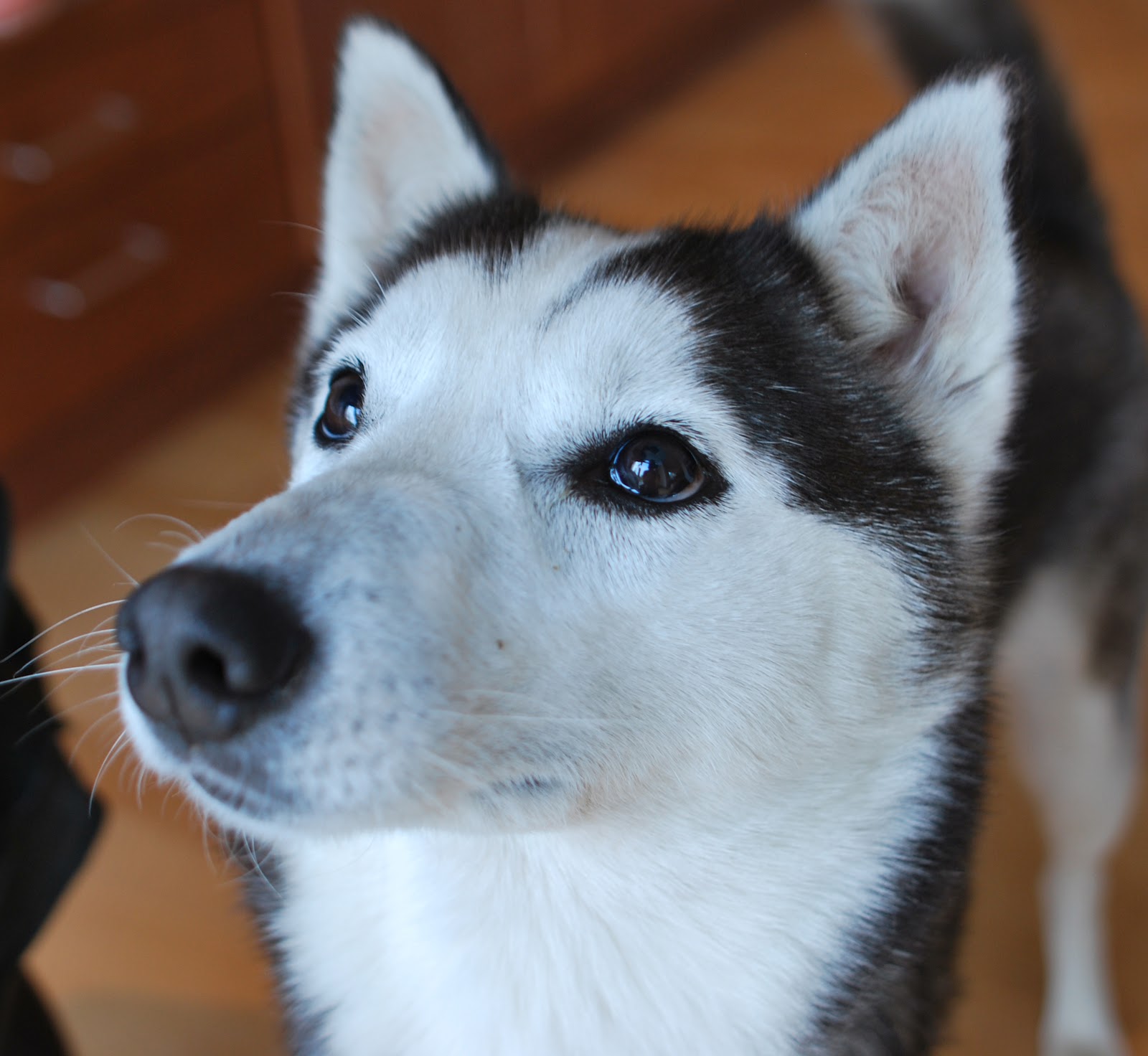
Siberian Husky

The most familiar coloring of the Siberian Husky, black and white, with ice blue eyes.
 Siberian huskies loves people! They are extremely people-oriented and love to cuddle. They are useless guard dogs, they will greet the burglar just as happily as your invited friends, but they will definitely let you know when someone is coming. They are very talkative dogs, and when a person is coming, it's feeding time or they are in harness in front of a sled, ready to start running, they will let you know by happily howling, barking and whining. Their passion in life is running, and when you see a team of Siberians in front of the sled, you can clearly see that they love to work.  


4 happy Siberians doing what they do best! Photo: Monica A. Sundset


 The Siberian Husky that we know today comes from the United States. The origin of the dogs, however, can be traced to Siberia where the Chukchi people used the dogs for pulling sleds. The dogs that would later be the origin of the Siberian husky came to Alaska in the early 1900s and where used for transport during the gold rush and to bring mail to distant parts of the state. The dogs became famous after the "serum race" to Nome, where the inhabitats lives where saved by the serum the dogs transported to them.


Tessa, a typical Siberian Husky of show type. She is heavily built with very thick undercoat.

Noor, a much lighter built working dog type.

Appearance

The Siberian husky is a medium sized dog, weighing 16-27 kg (35-60 lbs). The length of the body from the point of the shoulder to the base of the tail is slightly longer than the height of the body from the ground to the top of the withers. All colors of the coat from black to pure white are allowed. The eyes can be either brown, blue, one of each color or "parti-colored" (meaning both blue and brown in the same eye). For more details about the appearance, see the breed standard here: Breed standard Siberian Husky
 The modern Siberian Husky comes in two types: the show type, that most closely resembles the original dogs in appearance, and the working sled dog type, that has maintained the working capacity of the original dogs. The show type often lacks the discipline to work hard, and indeed often has a too thick and warm coat even to be able to. The working huskies are much more slender and often more thinly coated than the original dogs and while they might be faster than the original dogs, aren't as well equipped when it comes to sleeping out in the snow at extremely low temperatures. Most Siberians however, fall somewhere between these two extremes and can both work hard in front of the sled and keep warm during cold arctic nights, provided they are trained and used to sleeping outdoors. 


Beautiful Ylva with her dark brown eyes.


Siberian Huskies come in many different colors. These three are siblings, but could not look more different from each other.

Health

As in most other medium- to large sized dogs hip dysplasia does occur in the breed, but is rare. Only about 2% of all tested Siberians in the US showed signs of hip dysplasia. More common health issues are different defects of the eyes (juvenile cataracts, corneal dystrophy, canine glaucoma and progressive retinal atrophy). Other medical problems include seizures and congenital laryngeal paralysis. In general the Siberian husky is a healthy breed however, and non of the medical conditions mentioned are common. To avoid the genes for these conditions being spread in the population, all breeding animals should be checked for HD and preferably have their eyes examined by an veterinarian who is an expert in eye disorders.


Me with Birk and Tessa on a walk in the mountains.

Training

The Siberian Husky is a relatively small working type dog. They can be used for pulling sleds (or bikes or carts etc) from approximately 1 year of age. These are dogs that need to get plenty of physical exercise to be happy. They will not be content with a walk around the block.
Siberians  will respond to obedience training, provided you find a reward they are willing to work for. If your goal is top scores at obedience competitions however, you should probably chose another breed.
Huskies have a very strong prey drive and will kill other small animals, especially if they are two or more dogs running lose.If your husky is socialized with cats and other small pets from puppyhood, your other pets are safe, but your neighbor's cat will most likely still be regarded as fair game by your husky. So always keep your Siberian on leash when outdoors.  The strong prey drive can however also be used to our advantage as a reward in training.
Siberian huskies can be great with children, but remember, never let a child and a dog play unsupervised, no matter how friendly the dog is.

My boyfriend Mads on the cart, Noor and Vida in the back and Birk in front, during summer training. Always be careful when exercising Siberians in the summer, they can get heat exhaustion quickly, beacuse of their thick fur. Here in northern Norway however, that is rarely a problem... 

 If you like running or long walks, if you are willing to put in the time needed when it comes to socialization, training and exercise, then the Siberian husky might be what you are looking for. If properly trained and exercised, a Siberian will be your best friend!

Me and Tessa, a very loving Siberian that loves being close to people (preferably on their lap) more than anything else! Photo: Monica A. Sundset